∴ Ratio Press · Debut Title
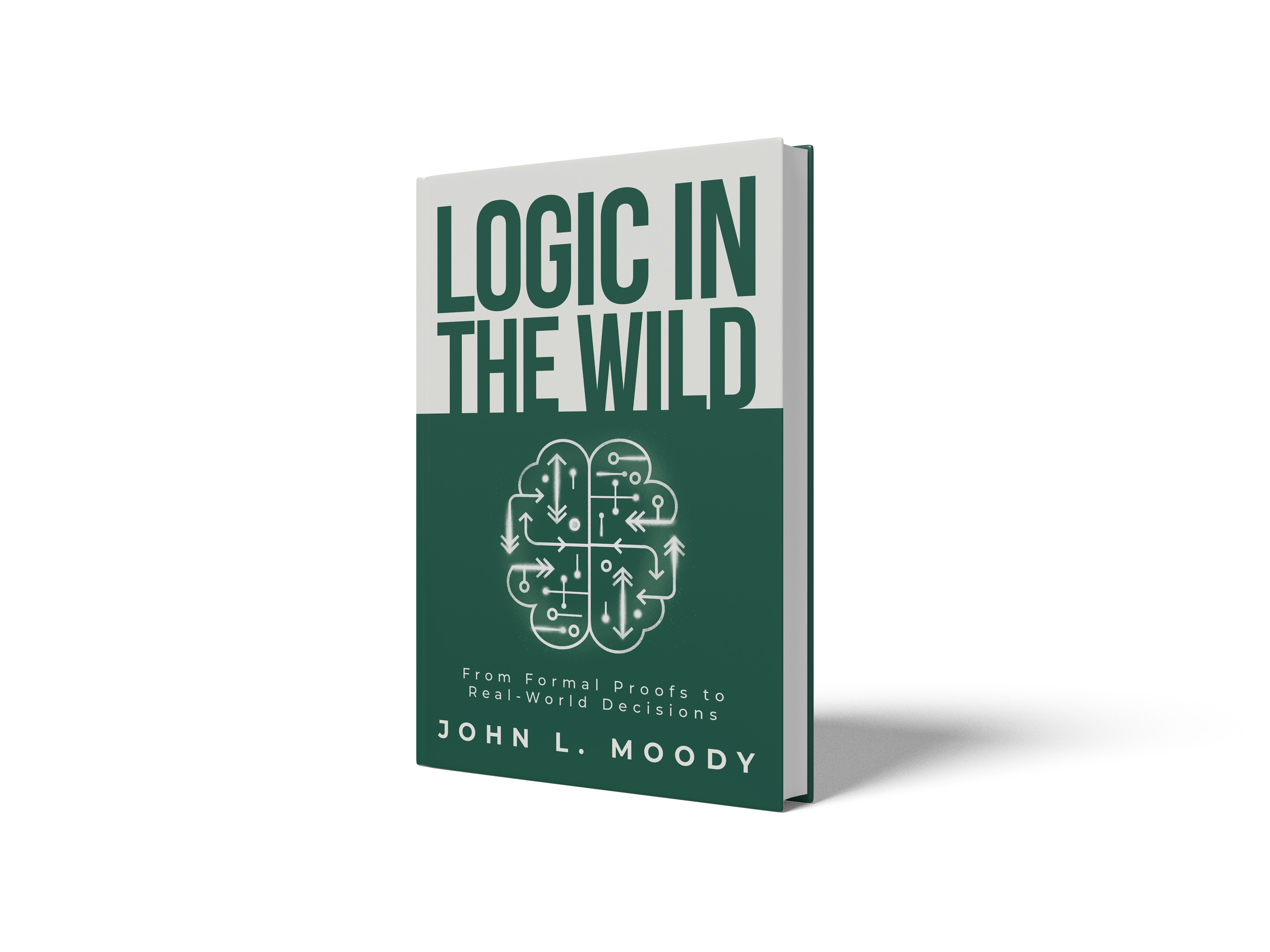
Logic in the Wild
From Formal Proofs to Real-World Decisions
Formal logic is the toolkit that makes you reason well every time. Not just know that an argument is bad — but know exactly why, and be able to prove it.
Kindle, paperback, and hardcover — all on Amazon.
What this is
Not a textbook. A working tool.
Textbooks cost $80–150 and are written for classroom adoption. They're comprehensive, dry, and structured around a 15-week semester. Logic in the Wild is structured around understanding.
Every chapter connects formal techniques to real decisions — debugging a conditional chain in code, evaluating a business proposal, reading a contract, catching a misleading statistic, and making better decisions under pressure.
By the end, you won't just be better at winning arguments. You'll be better at knowing which arguments are worth winning — and which ones you're currently winning by accident.
Want a taste before you buy? Grab the Fallacy Field Guide — 35 logical fallacies on one free reference card.
Get the free PDF →Who it's for
Built for people who think for a living.
Developers
If you've spent two hours debugging logic that turned out to be a boolean precedence error, this book is for you. Formal logic is how you write conditional chains that say what you mean.
Professionals
Managers, analysts, consultants, lawyers — anyone who sits in meetings where arguments get made and decisions follow. The toolkit for evaluating proposals, catching hidden premises, and asking the right question.
Students
Preparing for formal logic courses, the LSAT, or graduate admissions. Full coverage of propositional logic, predicate logic, categorical syllogisms, and fallacies — with worked examples throughout.
Curious Readers
Anyone who wants to understand how reasoning actually works under the hood — and why smart people so often get it wrong. No prerequisites. Starts from zero, takes you all the way through formal proofs.
What's inside
18 chapters. ~40,000 words. 224 pages. No prerequisites.
What Logic Actually Is (And What It Isn't)
Validity vs. truth. Why your gut feeling isn't an argument. What formal logic can and can't do for you.
Propositions — The Building Blocks
What a proposition is, cognitive vs. emotive meaning, intension and extension, and what makes a definition actually good.
Arguments — Premises, Conclusions, and the Space Between
Argument structure, deductive vs. inductive, validity vs. soundness, and how to map extended arguments.
Categorical Logic — Statements About Categories
The four categorical forms, the square of opposition, Venn diagrams, and the rules of the valid syllogism.
Logical Connectives — And, Or, Not, If-Then
AND, OR, NOT, IF-THEN, biconditional. Truth-functional definitions. Why "if-then" doesn't mean what most people think.
Truth Tables — The Machine That Settles Arguments
Constructing truth tables, testing for validity, tautologies, contradictions, and the indirect method shortcut.
Logical Equivalences and Why They Matter
De Morgan's Laws, double negation, contraposition, material implication. The moves that let you rewrite arguments cleanly.
Rules of Inference — The Valid Moves
Modus Ponens, Modus Tollens, Hypothetical Syllogism, Disjunctive Syllogism, Constructive Dilemma, and more.
Building Proofs
Proof strategy, direct proof, indirect proof, conditional proof. Multiple worked examples from simple to complex.
Beyond Propositions — Predicates and Quantifiers
Predicates, variables, constants, ∀ and ∃. Translating English into predicate logic, including scope and the domain of discourse.
Quantifier Rules and Predicate Proofs
The four quantifier rules with restrictions. Predicate logic proofs and quantifier negation (¬∀ ≡ ∃¬).
Putting It All Together — A Complete Derivation
A full worked example using everything from the book — propositions, quantifiers, inference rules, proof strategy.
Relational Predicates and Identity
Multi-place predicates, overlapping quantifiers (∀x∃y vs ∃x∀y), the identity predicate, uniqueness claims.
When Certainty Isn't the Goal
Strong vs. cogent arguments. The four inductive forms: statistical generalization, analogy, causal inference, abduction. How deductive and inductive reasoning work together.
Formal Fallacies — The Invalid Moves That Look Valid
Affirming the Consequent, Denying the Antecedent, Undistributed Middle, Illicit Major/Minor, Existential Fallacy.
Informal Fallacies — The Tricks People Play
The thirteen fallacies of relevance: Ad Hominem, Genetic Fallacy, Tu Quoque, Appeal to Authority, Appeal to Force, Appeal to Pity, Appeal to Emotion, Bandwagon, Appeal to Tradition, Sunk Cost, Red Herring, Straw Man, Missing the Point.
Informal Fallacies — Assumption and Language
Fallacies of presumption, ambiguity, and illicit transference: Begging the Question, False Dilemma, Slippery Slope, Hasty Generalization, False Cause, Equivocation, Composition, Division, and more.
Logic in the Wild
Six extended case studies: an access control PR, a vendor deck, a political op-ed, a contract clause, a press release, and a job offer you can't decide on.
Appendices
Symbolic reference · Practice problems with full solutions · The Logic of the Logos — a real-world exercise in predicate logic derivation